Canada PR for Accountants 2026
Section 1: Understanding NOC Code 11100 for Accountants
Before you build your Express Entry profile, you must confirm your correct NOC code. In Canada's National Occupational Classification (NOC) 2021 system, accountants fall under NOC 11100 - Financial Auditors and Accountants. This is a TEER 1 occupation, which means it qualifies for all three federal Express Entry programs: FSW, CEC, and FSTP (where applicable).
|
NOC Code |
TEER Level |
Job Title Examples |
Express Entry Eligible |
|
11100 |
TEER 1 |
Chartered Accountant (CPA, CA) |
Yes - All Programs |
|
11100 |
TEER 1 |
Certified General Accountant (CPA, CGA) |
Yes - All Programs |
|
11100 |
TEER 1 |
Management Accountant (CPA, CMA) |
Yes - All Programs |
|
11100 |
TEER 1 |
Financial Auditor |
Yes - All Programs |
|
11100 |
TEER 1 |
Tax Specialist / Tax Auditor |
Yes - All Programs |
|
11100 |
TEER 1 |
Cost Accountant |
Yes - All Programs |
What Does NOC 11100 Cover?
NOC 11100 covers professionals who examine and analyze accounting and financial records to ensure accuracy and compliance. Accountants under this NOC plan, organize, and administer accounting systems for both private and public sector establishments. If you work independently as a self-employed accountant, you still qualify under this code.
The most important step is verifying that your job duties match the NOC 11100 description. Canada uses a lead statement and main duties system. Your reference letter from your employer must clearly reflect these duties.
Key Job Duties Under NOC 11100
• Examine journal entries, ledger records, bank statements, and financial documents for accuracy
• Prepare financial statements including balance sheets and income statements
• Ensure compliance with established accounting standards and regulations
• Advise management on accounting and financial practices
• Conduct internal audits and prepare detailed audit reports
• Prepare tax returns and perform tax planning for individuals and organizations
• Design and implement accounting information systems
Section 2: CRS Score Requirements for Accountants in 2026
The CRS score you need as an Canada PR for Accountants depends entirely on which pathway you choose. There is no single fixed number. The Canadian immigration system uses pool-based draws, where the cutoff changes with each round. However, you can target realistic score ranges based on 2025 and 2026 draw history.
|
Draw Category |
2026 Typical CRS Cutoff |
How Accountants Qualify |
Strategy |
|
General All-Program Draw |
470 to 525 |
FSW or CEC eligible |
Maximize age, education, IELTS |
|
Canadian Experience Class (CEC) |
515 to 540 |
Must have 1 yr Canadian work exp |
Ideal if you already work in Canada |
|
French Language Draw |
379 to 435 |
Must have NCLC 7 in French |
Best option for bilingual accountants |
|
PNP-Linked Draw |
700 to 800+ |
After provincial nomination +600 |
PNP first, then federal draw |
|
Healthcare Category Draw |
462 to 476 |
Does NOT apply to NOC 11100 |
Not applicable for accountants |
|
Important: No General All-Program Draw Since April 2024 The last general all-program Express Entry draw occurred on April 23, 2024 with a CRS cutoff of 529. Since then, IRCC has only held category-specific draws (CEC, French, Healthcare, PNP). For accountants without category eligibility and without Canadian work experience, the PNP route is now the most viable pathway. The CEC draw is currently the most active draw type, with cutoffs between 515 and 540 in 2026. |
How Your CRS Score as an Accountant Breaks Down
Your CRS score comes from four sections. As an accountant with a university degree, you already have a strong foundation. Here is a realistic breakdown for a typical accountant profile:
|
CRS Section |
Factor |
Points Available |
Typical Accountant Score |
|
Section A - Core Human Capital |
Age (25-29 years) |
110 max |
110 |
|
Section A - Core Human Capital |
University Degree (Bachelor) |
120 max |
120 |
|
Section A - Core Human Capital |
IELTS CLB 9 (First Language) |
124 max |
100-124 |
|
Section A - Core Human Capital |
Foreign Work Experience (4+ yrs) |
80 max |
50-80 |
|
Section B - Spouse Factors |
If applicable |
40 max |
0-40 |
|
Section C - Skill Transferability |
Education + Language combo |
50 max |
25-50 |
|
Section C - Skill Transferability |
Work Exp + Language combo |
50 max |
25-50 |
|
Section D - Additional Points |
PNP Nomination |
600 |
0 or 600 |
|
Section D - Additional Points |
French Language Bonus |
50 max |
0-50 |
|
Section D - Additional Points |
Sibling in Canada |
15 |
0 or 15 |
Sample CRS Score Calculation: Accountant Profile
|
Profile Factor |
Details |
CRS Points |
|
Age |
27 years old |
110 |
|
Education |
Bachelor of Commerce (Accounting) |
120 |
|
First Language (IELTS) |
L:8 R:8 W:7 S:7 = CLB 8 average |
92 |
|
Foreign Work Experience |
3 years as accountant |
50 |
|
Skill Transferability (Education + Language) |
Degree + CLB 7+ = 25 pts |
25 |
|
Skill Transferability (Work Exp + Language) |
1+ yr foreign exp + CLB 7+ = 25 pts |
25 |
|
No spouse included |
Single applicant |
0 |
|
No PNP nomination |
Federal pool only |
0 |
|
No French language |
English only |
0 |
|
TOTAL CRS SCORE |
|
422 |
|
With PNP nomination (+600) |
Provincial pathway |
1022 |
|
With French CLB 7 added (+50) |
Bilingual bonus |
472 |
This sample shows why the PNP route is so powerful. A score of 422 alone will not get an ITA in 2026 from a general or CEC draw. But with a provincial nomination adding 600 points, this same profile becomes virtually guaranteed an ITA. Similarly, adding French language proficiency at NCLC 7 brings the score to 472, which is competitive for French language draws.
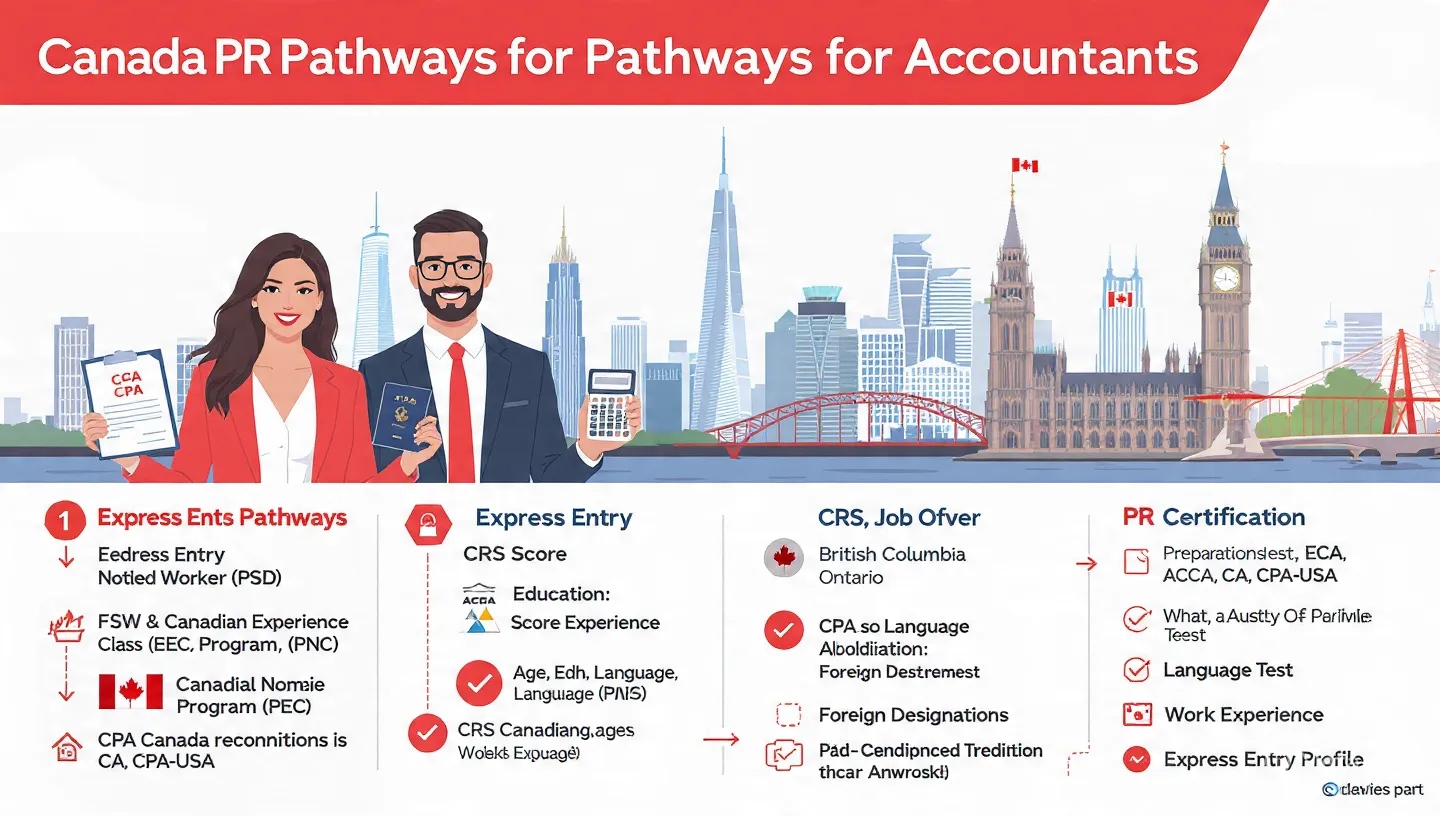
Section 3: Three Express Entry Programs Available to Accountants
1. Federal Skilled Worker Program (FSW)
The FSW program is the best option for accountants who have no Canadian work experience and are applying from outside Canada. To qualify, you need at least one year of continuous full-time paid work experience in NOC 11100 within the last 10 years.
You must also score at least 67 points on the FSW 100-point grid, which assesses education, language, work experience, age, arranged employment, and adaptability. Most accountants with a university degree and CLB 7 IELTS scores comfortably achieve 67+ points on this grid.
|
FSW Factor |
Max Points |
Typical Accountant Score |
|
Education |
25 |
21-25 (Bachelor or higher) |
|
Official Language (English) |
28 |
20-28 (CLB 7-9) |
|
Work Experience (1-6 yrs) |
15 |
9-15 |
|
Age (18-35 years) |
12 |
10-12 |
|
Arranged Employment |
10 |
0 (most applicants) |
|
Adaptability |
10 |
5-10 |
|
TOTAL |
100 |
65-90 typical |
2. Canadian Experience Class (CEC)
The CEC is for accountants who have already gained at least one year of skilled work experience in Canada. This is the most active draw type in 2026, with draws happening every two to four weeks. The CEC cutoffs in 2026 have ranged from 515 to 540.
If you are currently working in Canada under a work permit or Post-Graduate Work Permit (PGWP), you should prioritize building your CEC eligibility. One full year of Canadian work experience in NOC 11100 makes you eligible for CEC draws, which have a much more predictable timeline than FSW federal pool draws.
3. Provincial Nominee Program via Express Entry (PNP)
The PNP is currently the most powerful route for accountants whose CRS score is below 500. When a province nominates you, you receive an automatic 600-point boost to your CRS score, virtually guaranteeing an ITA in the next federal draw. Each province has different streams, and some specifically target accountants and finance professionals.
Section 4: Best PNP Streams for Accountants in 2026
Multiple provinces actively seek accountants through their PNP streams. Each province has different CRS base requirements, different processing times, and different settlement obligations.
|
Province |
PNP Stream |
Base CRS Required |
Canadian Exp Required |
Key Benefit |
|
Ontario |
OINP Human Capital Priorities |
400+ |
No (FSW eligible) |
Largest job market for accountants |
|
British Columbia |
BC PNP Skills Immigration |
350+ (with job offer) |
6 months preferred |
Strong Big 4 firm presence |
|
Alberta |
AINP Express Entry Stream |
300+ |
No |
No provincial income tax |
|
Nova Scotia |
NSNS Labour Market Priorities |
No fixed minimum |
No |
Specific accounting occupation draws |
|
Manitoba |
MPNP Skilled Workers in Manitoba |
Job offer required |
No |
Lower cost of living |
|
Saskatchewan |
SINP Express Entry |
400+ |
No |
Fast processing, low congestion |
|
New Brunswick |
NB Express Entry |
67 FSW points |
No |
Smaller pool, faster decisions |
|
Ontario PNP - Human Capital Priorities Stream for Accountants Ontario runs targeted draws from the Express Entry pool for specific occupations. NOC 11100 has been invited in multiple Ontario Human Capital Priorities draws. There is no job offer required, but you must have an active Express Entry profile. Ontario has over 30 percent of all accounting job openings in Canada, making it the top destination for immigrant accountants. Check the OINP website regularly as draws are announced without advance notice. |
Section 5: IELTS Requirements for Accountants
Language proficiency is one of the highest-scoring factors in the CRS system. Even a small improvement in your IELTS score can add 20 to 50 CRS points. Understanding the minimum requirements and the optimal target scores will make a significant difference in your competitiveness.
|
Program |
Minimum CLB |
Minimum IELTS (L/R/W/S) |
Recommended for Higher CRS |
|
FSW (NOC 11100) |
CLB 7 |
L:6.0 R:6.0 W:6.0 S:6.0 |
CLB 9: L:8.0 R:7.0 W:7.0 S:7.0 |
|
CEC (NOC 11100 - TEER 1) |
CLB 7 |
L:6.0 R:6.0 W:6.0 S:6.0 |
CLB 9 preferred for 515+ CRS target |
|
French Language Draw |
NCLC 7 (French) |
TEF/TCF equivalent |
NCLC 9 for maximum points |
|
PNP Stream (most provinces) |
CLB 7 |
L:6.0 R:6.0 W:6.0 S:6.0 |
CLB 8+ for stronger profile |
CRS Points Gained by Improving IELTS
|
IELTS Level (Average) |
CLB Level |
Core Language Points (Single) |
Improvement vs CLB 7 |
|
L:6 R:6 W:6 S:6 |
CLB 7 |
88 points |
Baseline minimum |
|
L:7 R:6.5 W:6.5 S:6.5 |
CLB 8 mix |
103 points |
+15 points |
|
L:8 R:7 W:7 S:7 |
CLB 9 average |
124 points |
+36 points |
|
L:8.5 R:8 W:7.5 S:8 |
CLB 10 |
136 points |
+48 points |
The message is clear: if you have not taken IELTS yet or scored CLB 7 previously, retaking the exam and achieving CLB 9 can add 36 or more points to your CRS score. This is often the most cost-effective investment you can make before applying for Express Entry.
Section 6: Educational Credential Assessment (ECA) for Accountants
An Educational Credential Assessment (ECA) verifies that your foreign accounting degree is equivalent to a Canadian credential. An ECA is mandatory if you were educated outside Canada and are applying under FSW. For CEC applicants, the ECA is not required but adds to your profile's strength.
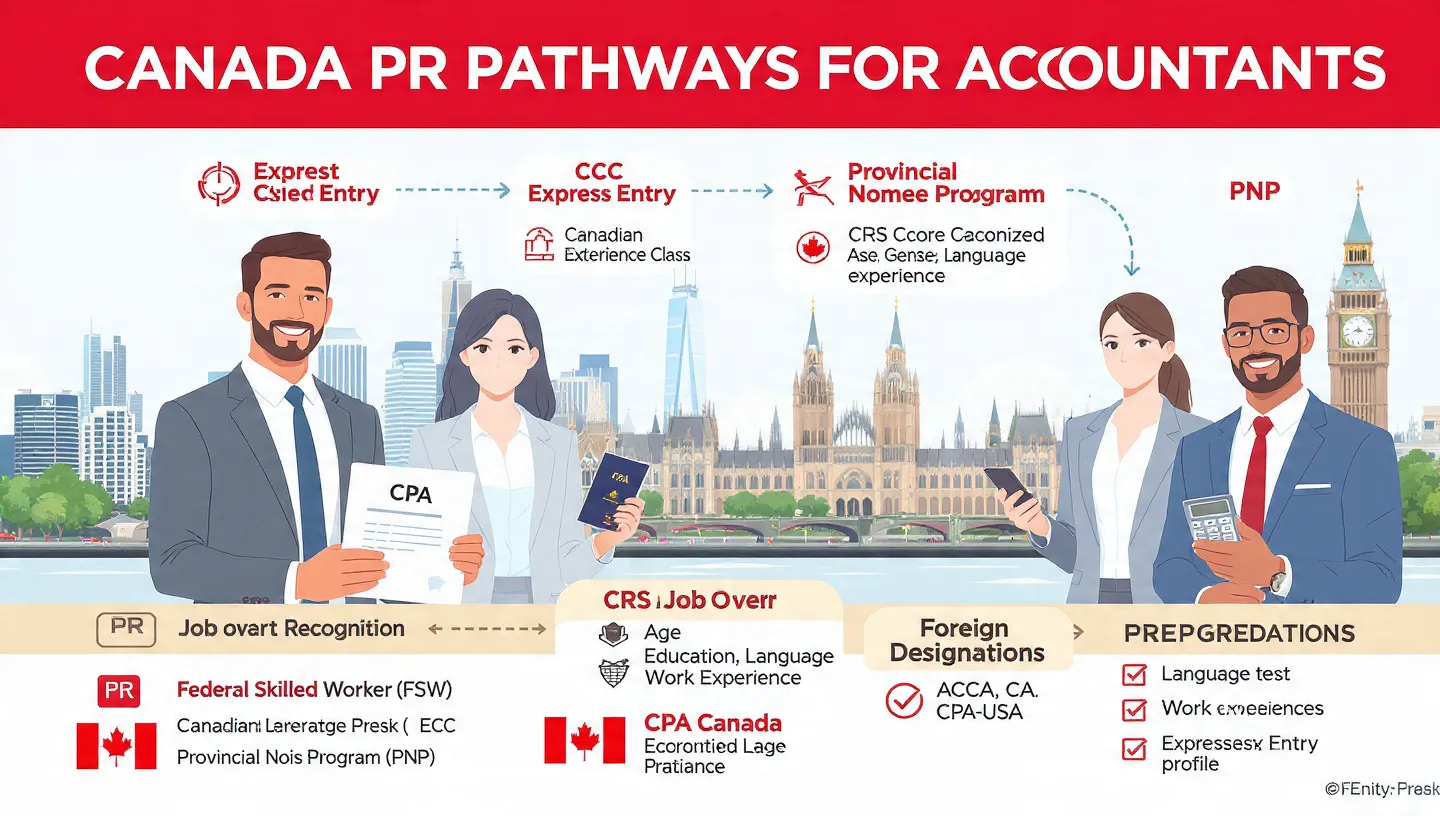
Designated ECA Bodies for Accountants
|
ECA Organization |
Specialization |
Processing Time |
Fee (Approx.) |
|
WES - World Education Services |
All degrees, most popular globally |
7 to 10 weeks |
CAD 220-260 |
|
ICAS - International Credential Assessment Service |
All degrees |
4 to 8 weeks |
CAD 200-250 |
|
CPA Canada |
Accounting degrees specifically |
Variable |
Varies by province |
|
IQAS - Alberta |
All degrees (Alberta residents) |
16 to 18 weeks |
CAD 200 |
|
MIFI (Quebec applicants) |
Quebec skilled worker |
Quebec stream only |
Varies |
|
Special Note for Francophone Accountants from West Africa If you studied at a French-language university such as Universite de Lome (Togo), Universite de Yaounde (Cameroon), or Universite d'Abomey-Calavi (Benin), WES is the most globally recognized ECA provider. Your transcripts must be sent directly from the university to WES - you cannot send them yourself. French-language documents must be accompanied by certified English or French translations done by an IRCC-designated translator. Allow extra time if your university takes 4 to 8 weeks to mail transcripts internationally. |
Section 7: Canadian Accounting Salaries by Province
Understanding Canadian salary ranges helps you determine whether your expected earnings meet provincial requirements and where you will maximize your career potential as an immigrant accountant.
|
Province |
Entry Level (0-3 yrs) |
Mid-Level (4-7 yrs) |
Senior Level (8+ yrs) |
With CPA License |
|
Ontario (Toronto) |
CAD 55,000-70,000 |
CAD 80,000-100,000 |
CAD 110,000-140,000 |
CAD 120,000-180,000 |
|
British Columbia (Vancouver) |
CAD 52,000-68,000 |
CAD 75,000-95,000 |
CAD 105,000-130,000 |
CAD 115,000-165,000 |
|
Alberta (Calgary) |
CAD 55,000-72,000 |
CAD 78,000-98,000 |
CAD 108,000-138,000 |
CAD 120,000-175,000 |
|
Nova Scotia (Halifax) |
CAD 45,000-58,000 |
CAD 65,000-80,000 |
CAD 85,000-110,000 |
CAD 95,000-130,000 |
|
Manitoba (Winnipeg) |
CAD 48,000-60,000 |
CAD 68,000-82,000 |
CAD 88,000-110,000 |
CAD 98,000-130,000 |
|
Saskatchewan (Regina) |
CAD 50,000-62,000 |
CAD 70,000-85,000 |
CAD 90,000-112,000 |
CAD 100,000-135,000 |
Section 8: CPA Designation - Is It Required for Canada PR?
This is one of the most frequently asked questions by immigrant accountants. The short answer is: CPA designation is NOT required to obtain Canada PR. You do not need a Canadian CPA license to submit your Express Entry profile or receive a provincial nomination.
However, once you arrive in Canada and wish to practice public accounting professionally - signing audited financial statements, providing public accounting services - you will need to register with the CPA provincial body in your province.
International Accounting Designations Recognized in Canada
|
Country / Designation |
Recognition in Canada |
CPA Equivalency Path |
|
ACCA (UK) |
Widely recognized |
Fast-track through MOU with CPA Canada |
|
ICAI - CA (India) |
Recognized under MOU |
Module exemptions available |
|
ICAEW - ACA (UK) |
Recognized under MOU |
Joint final exam only |
|
CPA (USA) |
High recognition |
Province-specific bridging |
|
Ordre des Experts-Comptables (France) |
Recognized in Quebec |
MIFI assessment process |
|
OHADA CPA (West Africa) |
Limited formal recognition |
Full CPA PEP required typically |
|
Togo / Other Francophone Africa |
ECA from WES accepted for PR |
CPA PEP enrollment after arrival |
Section 9: Eight Ways to Boost Your CRS Score as an Accountant
Strategy 1: Retake IELTS and Achieve CLB 9
Moving from CLB 7 to CLB 9 adds approximately 36 core points and also unlocks higher skill transferability points. This is the single most impactful move for most accountants below 500 CRS.
Strategy 2: Learn French and Claim the 50-Point Bilingual Bonus
If you achieve NCLC 7 in French while maintaining CLB 7 in English, you earn an additional 50 CRS points for bilingualism. Francophone accountants from countries like Togo, Cameroon, and Ivory Coast have a natural advantage here. French language draws also have CRS cutoffs sometimes below 400.
Strategy 3: Apply for a Provincial Nomination (PNP)
This is the most powerful strategy available. A provincial nomination adds 600 points to your CRS, giving an effective total that guarantees an ITA. Ontario, BC, Alberta, and Nova Scotia have nominated accounting professionals in recent years.
Strategy 4: Gain Canadian Work Experience
Working in Canada - even on a temporary work permit for one year - qualifies you for the Canadian Experience Class. CEC draws in 2026 have been frequent and the pool is smaller and more competitive than FSW. One year of Canadian work experience also adds 40 CRS points directly.
Strategy 5: Upgrade Your Education
A Master's degree in Accounting, Finance, or Business Administration earns more CRS points than a bachelor's degree. If you completed or are completing a Canadian master's degree, you also qualify for the 30-point Canadian education bonus.
Strategy 6: Add Your Spouse Strategically
If your spouse has strong IELTS scores (CLB 7 or higher) and a university education, including them in your Express Entry profile can add up to 40 points. However, adding a spouse reduces your own core human capital ceiling from 600 to 460 points, so calculate whether the net result is positive for your specific profile before making this decision.
Strategy 7: Claim Sibling Bonus if Applicable
If you have a Canadian citizen or permanent resident sibling living in Canada, you are eligible for 15 additional CRS points. This is often overlooked by applicants.
Strategy 8: Enter Pool Early for Tie-Breaking Advantage
When two profiles have identical CRS scores, the profile that was submitted first receives the invitation. Entering the pool now - even before you optimize your score - establishes your timestamp. If you later update your profile with a better IELTS score or add ECA results, your timestamp is reset, so plan your submission timing carefully.
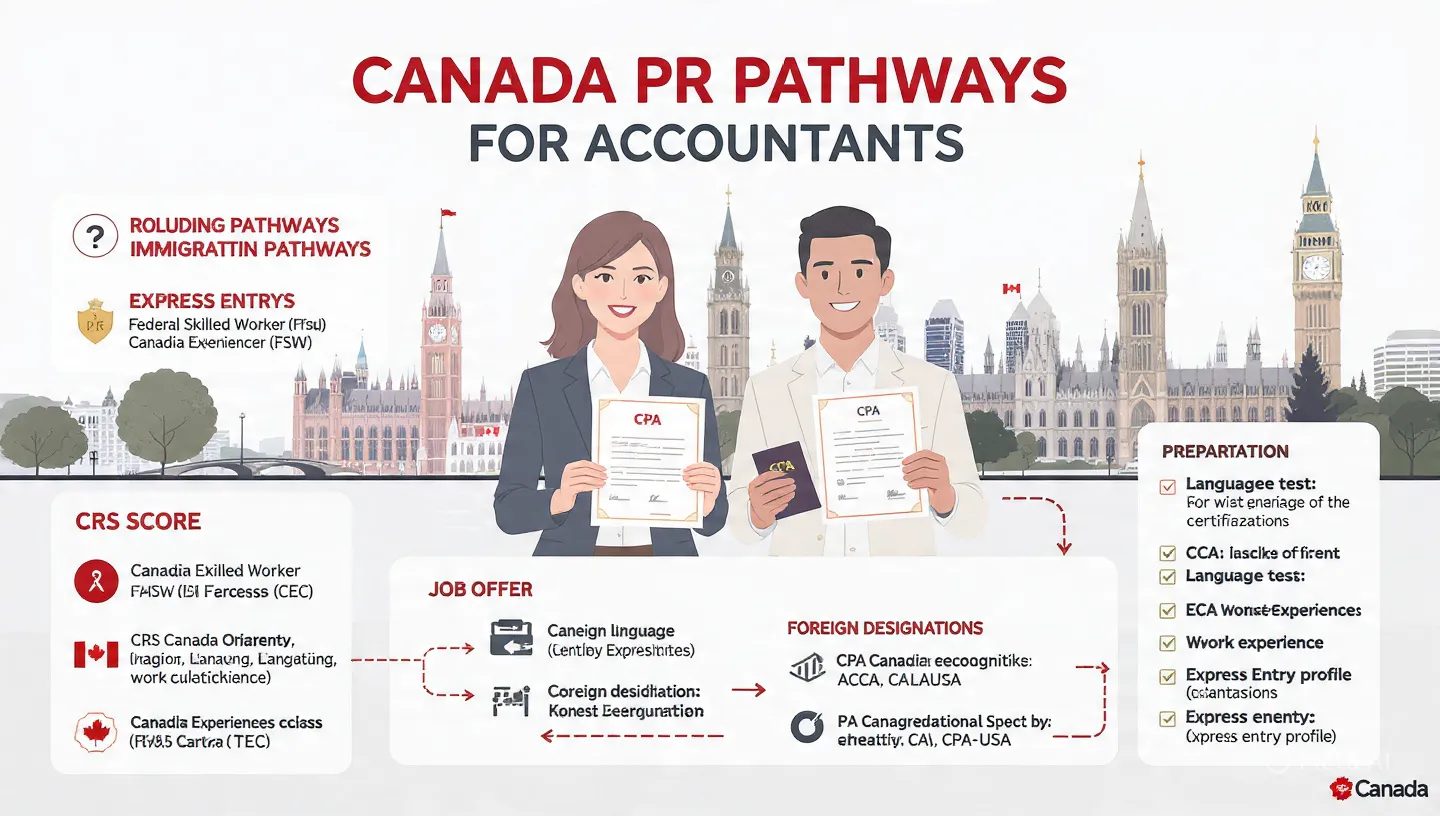
|
Strategy |
Points Gain Estimate |
Time to Implement |
Cost Estimate |
|
IELTS CLB 7 to CLB 9 |
+36 core, +25 skill = +61 total |
2 to 6 months study |
CAD 300-500 |
|
French NCLC 7 bilingual bonus |
+50 points |
12 to 24 months study |
CAD 500-2000 |
|
PNP Nomination |
+600 points (guaranteed ITA) |
3 to 12 months |
CAD 1,500-3,000 fees |
|
Canadian Work Experience (1 yr) |
+40 points + CEC eligibility |
12 months minimum |
Time investment |
|
Master's degree (Canadian) |
+30 bonus + higher CRS |
1 to 2 years |
CAD 20,000-60,000 |
|
Spouse IELTS improvement |
+10 to +20 points |
3 to 6 months |
CAD 300-500 |
|
Sibling in Canada |
+15 points |
Immediate (if eligible) |
No cost |
Section 10: Step-by-Step Process for Accountants Applying for Canada PR
1. Confirm Your NOC Code: Verify your job duties match NOC 11100 using the IRCC NOC finder tool at noc.esdc.gc.ca
2. Check Your FSW 67-Point Grid Score: Calculate your FSW points for education, language, experience, age, and adaptability
3. Take IELTS or CELPIP: Aim for CLB 9 minimum to maximize CRS points (or TEF/TCF Canada if bilingual in French)
4. Get Your ECA Done: Apply to WES, ICAS, or another designated body for your foreign accounting degree - allow 8 to 12 weeks
5. Create Your Express Entry Profile: Submit your complete profile at ircc.canada.ca with all documents ready
6. Calculate Your CRS Score: Use the IRCC CRS calculator to estimate your score and identify gaps
7. Apply to PNP Streams: Simultaneously apply to provincial streams that match your profile - especially Ontario, BC, and Alberta for accountants
8. Wait for ITA or PNP Nomination: Monitor your account regularly. ITA or nomination triggers your 60-day application window
9. Submit Permanent Residence Application: Upload all documents within 60 days of receiving ITA - no extensions are granted
10. Provide Biometrics and Medical Exam: Schedule these immediately after submitting your application
11. Receive COPR and Land in Canada: Once approved, your Confirmation of Permanent Residence allows you to land as a PR
Read More : NOC Code List for Healthcare Workers Canada
Section 11: Six Costly Mistakes Accountants Make During Canada PR Process
Mistake 1: Using the Wrong NOC Code
Some accountants apply under NOC 10010 (Financial Managers) instead of 11100. Financial Manager roles require significant supervisory responsibilities. If your actual work duties align more with 11100, applying as 10010 can lead to misrepresentation flags in your application.
Mistake 2: Submitting Without ECA Confirmation
Accountants from South Asia, Africa, and the Middle East frequently submit Express Entry profiles listing their degree without waiting for the official WES or ICAS ECA report. If IRCC cannot verify your credentials, your profile may be declined or your ITA may be cancelled.
Mistake 3: Not Exploring French Language as a Strategy
Many accountants from Francophone countries in West Africa already speak French but list only English on their Express Entry profile. By also taking the TEF Canada or TCF Canada test and claiming the French language bonus, they could add 50 points and qualify for French draws with cutoffs sometimes 80 to 100 points lower than general draws.
Mistake 4: Waiting for a General Draw That May Not Come
The last general all-program Express Entry draw was in April 2024. Accountants who have been sitting in the pool waiting for a general draw with a score of 450 to 510 have been waiting for over a year with no result. The strategic response is to pivot to PNP, improve your score, or develop French language proficiency.
Mistake 5: Including Spouse Without Calculating Net Effect
Adding a spouse feels intuitive, but many applicants lose points overall when their spouse's contributions are weaker than the reduction in core human capital ceiling. Always run the numbers both ways before finalizing your profile.
Mistake 6: Missing the 60-Day ITA Deadline
Once you receive an ITA, you have exactly 60 calendar days to submit your complete permanent residence application. IRCC does not grant extensions. Missing this window means your ITA is cancelled and you must re-enter the pool and wait for a new draw. Prepare all your documents - police clearances, medical exams, reference letters - before you expect to receive an ITA.
Section 12: 2026 Updates That Affect Accountants
|
Three Key 2026 Changes for Accountant Applicants Change 1 - Job Offer Points Removed (March 2025): IRCC removed CRS points for job offers in March 2025. Previously, a valid LMIA-backed job offer could add 50 or 200 CRS points. This removal disproportionately affected accountants who had arranged employment. Focus on IELTS, PNP, and French as alternatives. Change 2 - Senior Managers Draw (March 2026): The first Express Entry draw targeting Senior Managers (NOC 0111 Financial Managers) was held in March 2026 with a CRS cutoff of 429 and 250 invitations. This is different from NOC 11100 but opens a pathway for accountants who have moved into management roles. Change 3 - CEC as Dominant Draw Type: Throughout 2025 and into 2026, IRCC has prioritized CEC-specific draws. Accountants with Canadian experience are being invited at much higher rates than those in the FSW pool. If you can obtain Canadian work experience, this is now the priority pathway. |
Conclusion
Canada PR for accountants in 2026 is highly achievable with the right strategy tailored to your individual profile. The NOC 11100 classification places accountants in TEER 1, making them eligible for all major Express Entry programs. Whether you target the Canadian Experience Class with a CRS score above 515, pursue a provincial nomination to receive the 600-point boost, or leverage French language proficiency to access draws with cutoffs below 420, there is a concrete pathway for every accountant profile. Begin by confirming your NOC code, completing your ECA, and achieving the highest possible IELTS score before creating your Express Entry profile to maximize your CRS score and invitation probability.
Frequently Asked Questions
There is no fixed minimum CRS score. For Canadian Experience Class draws in 2026, competitive scores have ranged from 515 to 540. For French language draws, cutoffs have been as low as 379. For PNP-linked draws, your base CRS does not matter much because provincial nomination adds 600 points. Aim for 470+ as a baseline competitive score for general pool draws.
No. Canadian CPA designation is not required to receive your Express Entry ITA or to submit your permanent residence application. You can land in Canada as a PR without CPA and then pursue the designation after arrival. However, to practice public accounting professionally in Canada and sign financial statements, provincial CPA registration becomes necessary.
IELTS is the most common test, but it is not the only option. You can also use CELPIP-G for English, or TEF Canada or TCF Canada for French language claims. An official language test result from a designated testing organization is mandatory for all Express Entry streams.
Ontario is typically the best destination due to its high concentration of multinational corporations, Big 4 accounting firms, and government organizations all employing accountants. Alberta is attractive due to no provincial income tax. Nova Scotia is notable for running occupation-specific draws that have included accounting roles. British Columbia offers strong Big 4 firm presence in Vancouver.
Under Express Entry, IRCC aims to process complete applications within 6 months of receiving a complete application after ITA. However, this timeline can extend to 12 to 18 months if documents are incomplete, police certificates take time, or additional processing is required. PNP applications add provincial processing time (3 to 9 months before the federal step).
Yes. Accountants from Francophone African countries have a significant strategic advantage. By claiming both English and French language scores on their Express Entry profile, they qualify for the bilingual bonus of up to 50 CRS points. They also qualify for French language Express Entry draws where cutoffs have been 80 to 120 points lower than CEC draws. This makes the French language pathway the fastest realistic route for many Francophone African accountants.
Core documents include: valid passport, IELTS or CELPIP test results, ECA report from WES or ICAS, employment reference letters from all employers covering NOC 11100 duties, education transcripts, police clearance certificates from all countries lived in for 6+ months, and proof of funds meeting IRCC minimums. If applying via PNP, the provincial nomination certificate is also required before submitting to IRCC.
For FSW applicants, you must show proof of settlement funds unless you have a valid Canadian job offer or are already legally working in Canada. For a single applicant in 2026, the minimum is approximately CAD 13,757. For a couple with no children, this rises to approximately CAD 17,127. These amounts are set by IRCC and updated annually. CEC applicants are exempt from this requirement if currently working in Canada.
Share This Article