Germany Opportunity Card 2026 : Complete Guide from India & Pakistan
Germany currently has over 600,000 skilled worker positions vacant and for the first time, Germany has opened its doors to internationally trained professionals more easily than ever before. If you are an engineer, IT expert, nurse, or professional in any technical field who wants to build a life in Germany, the Germany Opportunity Card (Chancenkarte) is a game-changer for you.
Under the old immigration system, you had to find a job in Germany first while sitting in India or Pakistan then get employer sponsorship, and go through a lengthy recognition process. The Germany Opportunity Card has removed all these barriers. Now you can come to Germany, search for jobs yourself, meet companies in person, and once a job is confirmed, obtain permanent status.
📊 Quick Facts Germany Opportunity Card 2026
| Detail | Info |
|---|---|
| Visa Name | Chancenkarte (Opportunity Card) |
| Validity | 1 year — extendable in special cases |
| Work Allowed | Yes, 20 hours/week + 2-week trial placements |
| Job Offer Required | No — you can search after arriving in Germany |
| Minimum Points Required | 6 points (points-based system) |
| Blocked Account | ~€12,324 (~11 lakh INR) for 1 year |
| Visa Fee | €75 + VFS charges |
| Processing Time | 8 to 12 weeks |
| PR Possible | Yes — in 4 years, or 21 months with EU Blue Card |
What Is the Germany Opportunity Card? (Chancenkarte Explained)
The Germany Opportunity Card officially called the Chancenkarte was introduced in November 2023 under Germany's Skilled Immigration Act (Fachkräfteeinwanderungsgesetz) and has been fully operational since November 2024. It is a job-seeker visa that allows non-EU nationals to stay in Germany for 1 year and search for employment without a prior job offer.
This visa represents a revolutionary shift in Germany's immigration policy. Previously, Germany's model was employer-sponsored meaning you could not legally go to Germany without a confirmed job. Now Germany has adopted a points-based system similar to Canada and Australia, making it far more accessible for globally trained professionals.
Traditional Work Visa vs. Opportunity Card — What's the Difference?
| Feature | Traditional Work Visa | Opportunity Card (Chancenkarte) |
|---|---|---|
| Job Offer Required? | Yes — mandatory | No |
| Degree Recognition | Required upfront | Can happen later |
| Visa Validity | Job-dependent | 1 year fixed |
| Work Permission | Full-time | 20 hrs/week + 2-week trial |
| Family Allowed? | Yes (after job) | After job confirmation |
| Target Audience | Already confirmed professionals | Job seekers, fresh starters |
| PR Timeline | 4+ years | 4 yrs (21 months with Blue Card) |
Why Did Germany Need the Opportunity Card?
Germany is facing an aging workforce crisis. By 2030, Germany will need an estimated 7 million skilled workers. The IT sector alone has over 137,000 unfilled positions. Healthcare is so short of nurses and doctors that hospitals are running below capacity. This card is Germany's direct response to that crisis and it is a golden opportunity for qualified professionals from India and Pakistan.
Eligibility Who Can Apply?
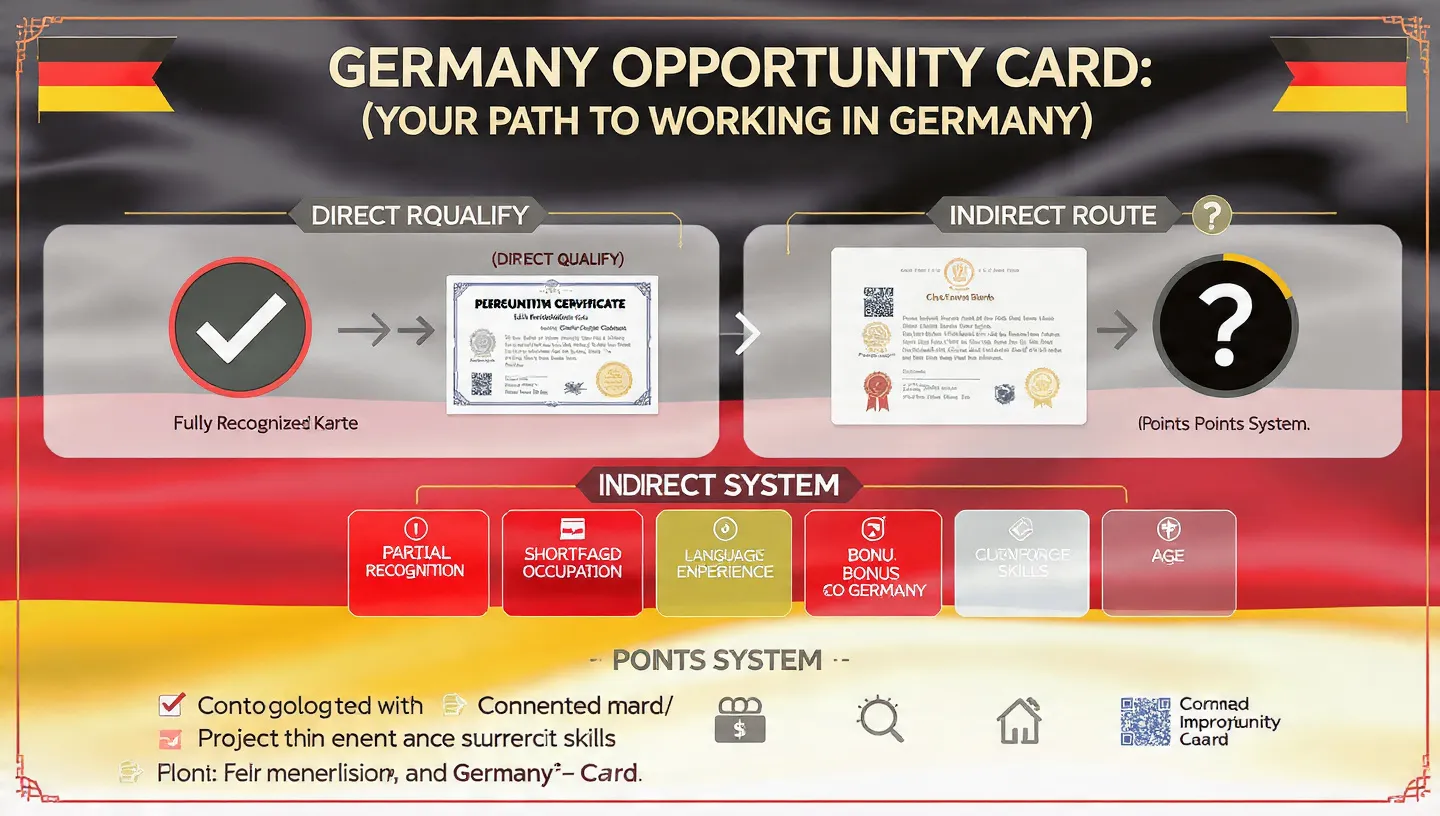
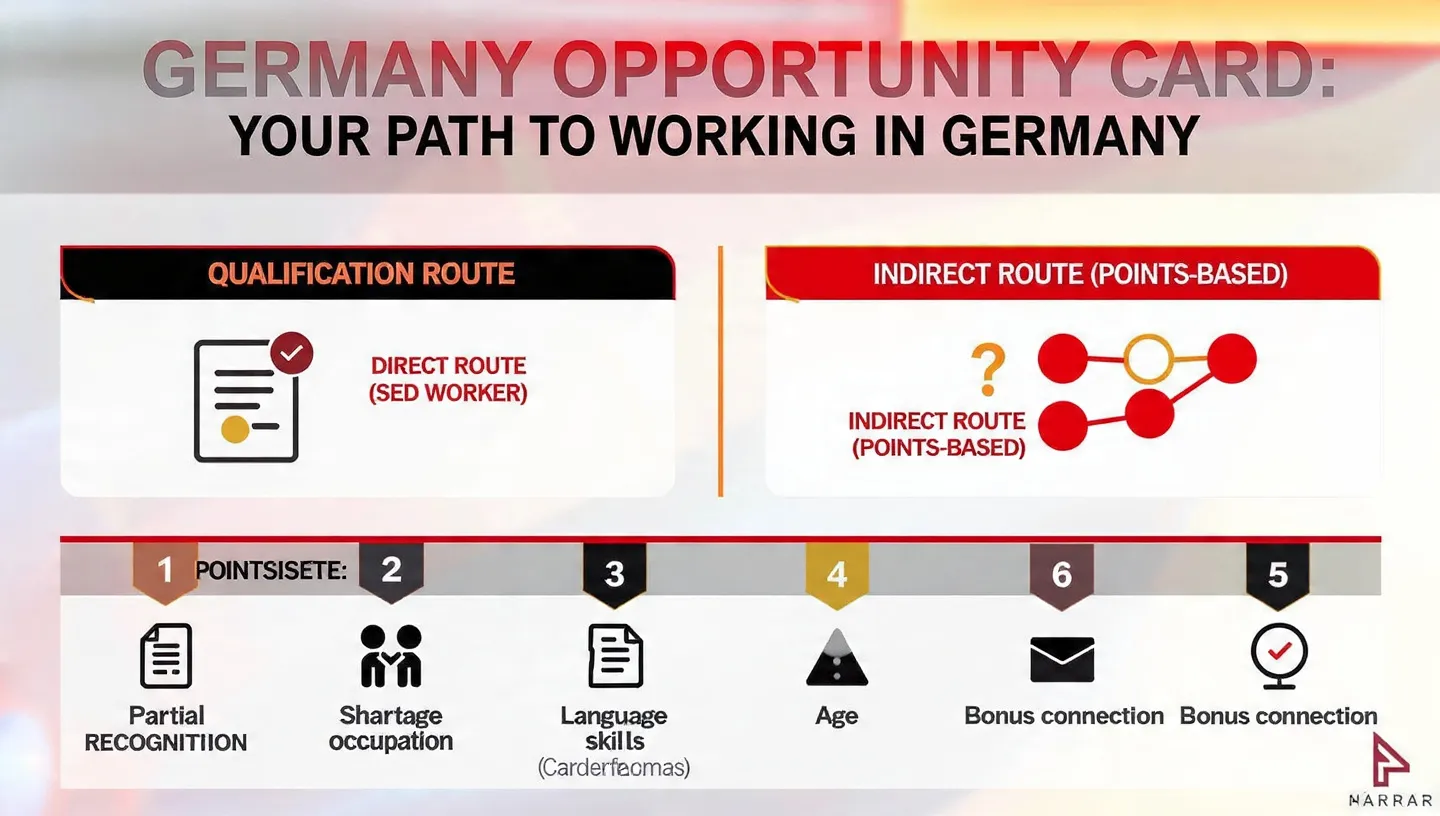
Eligibility for the Germany Opportunity Card comes through two pathways:
Pathway A Direct Qualification Recognition
If your degree or vocational training is officially recognized in Germany, you are directly eligible no points system needed. You can check whether your degree is recognized at anabin.de.
Pathway B Points-Based System (Minimum 6 Points)
| Criteria | Points | Notes |
|---|---|---|
| Qualified degree or vocational training | Prerequisite | Mandatory for both pathways |
| German language (B2 level) | 3 pts | Goethe B2, TestDaF, or DSH certificate |
| German language (A1/A2 level) | 1 pt | Basic but helpful for job search |
| English language (C1 level) | 2 pts | IELTS 7.0+, TOEFL 100+, Cambridge C1 |
| English language (B2 level) | 1 pt | IELTS 6.0+, TOEFL 87+ |
| Relevant work experience (2+ years) | 2 pts | Proof required |
| Degree from top-200 university | 2 pts | QS World Ranking top 200 |
| Age below 35 | 1 pt | Bonus for younger applicants |
| Spouse also qualified | 1 pt | Spouse's recognized qualification |
| Prior stay in Germany | 1 pt | Study, internship, or training |
| Concrete job offer (any field) | 1 pt | Even part-time counts |
💡 6 Points Achievable Even Without German!
Many Indian and Pakistani applicants don't know German but these combinations still work:
- Option 1: English C1 (2pts) + Work Exp 2yrs (2pts) + Top University Degree (2pts) = 6 pts ✓
- Option 2: English C1 (2pts) + Work Exp (2pts) + Age <35 (1pt) + Spouse Qualified (1pt) = 6 pts ✓
- Option 3: English B2 (1pt) + Work Exp (2pts) + Top University (2pts) + Age <35 (1pt) = 6 pts ✓
Special Condition for Applicants Aged 45+
Applicants over 45 must additionally show either proof of a minimum €46,770 gross annual salary, or demonstrate sufficient financial means. This condition does not apply to those whose degree is directly recognized.
Step-by-Step Application Process
Step 1 Eligibility Check (12 days) Count your points using the table above. If you have 6 or more, proceed. Use the points calculator on the Make it in Germany portal to double-check.
Step 2 Degree Recognition Check (1 week) Search your university and degree at anabin.de. 'H+' or 'H' status = recognized. If not listed, you can obtain a NARIC assessment.
Step 3 Gather Documents (24 weeks) Follow the complete checklist below. Prepare certified translations for every non-English document.
Step 4 Open a Blocked Account (12 weeks) Open a German blocked account via Fintiba, Expatrio, or Deutsche Bank all can be done online from India or Pakistan. Minimum for 2026: €12,324.
Step 5 Arrange Health Insurance (35 days) Book valid Germany travel health insurance for 1 year. MAWISTA, Care Concept, or Hanse Merkur are popular options.
Step 6 Book Consulate Appointment (ASAP 68 weeks in advance) Book via the German Consulate or VFS Global website.
- India: Mumbai, Delhi, Chennai, Hyderabad, Kolkata, Bangalore
- Pakistan: Islamabad, Karachi, Lahore
Step 7 Attend Visa Interview Bring all original documents + copies. Clearly explain your job search plan in Germany during the interview.
Step 8 Arrive in Germany Upon arrival, complete your Anmeldung (city registration) and register at the local Ausländeramt (foreigners office).
ℹ️ Realistic Processing Time: Standard is 8–12 weeks. During peak season (Jan–Mar, Sep–Oct), it can take 12–16 weeks. Have all documents ready when booking your appointment incomplete applications are rejected and you lose your place in the queue.
Complete Documents Checklist
A. Personal Documents
- Valid passport minimum 12 months validity remaining (original + 2 photocopies)
- 2 biometric passport photos white background, taken within the last 6 months
- Birth certificate original + certified translation
- Marital status proof Marriage Certificate/Nikah Nama (if applicable) + certified translation
- Police Clearance Certificate India: Passport Seva; Pakistan: NADRA/local police
B. Educational Documents
- Degree certificate original + certified translation
- All semester mark sheets/transcripts original + certified translation
- Proof of degree recognition / anabin.de printout (or NARIC/ENIC assessment)
- APS Certificate optional for Indian applicants, but sometimes required for certain German universities
C. Language Documents
- English: IELTS certificate (7.0+ for C1 = 2 pts), TOEFL, or Cambridge C1/C2
- German (if claiming points): Goethe-Institut certificate, TestDaF, DSH, or telc
D. Financial Documents
- Blocked account confirmation letter minimum €12,324 for 2026
- OR: Verpflichtungserklärung formal sponsorship declaration from a Germany resident
E. Other Required Documents
- Completed visa application form fill online and print
- Health insurance proof 1-year Germany coverage
- CV/Resume in German or English, max 2 pages, European format
- Motivation letter your job search plan, target industry, and relevant skills
- Visa fee payment proof €75
⚠️ Certified Translations Don't Make This Mistake All non-English/non-German documents require certified translation. In India, use only consulate-approved translators listed on the VFS Global website. In Pakistan, use Pakistan Translators Association (PTA) certified translators. Cost: approximately 500–2,000 INR / 300–1,500 PKR per page. Applications are rejected if uncertified translations are submitted.
Complete Cost Breakdown From India & Pakistan
| Expense | EUR | Indian Rupees (approx.) | Pakistani Rupees (approx.) |
|---|---|---|---|
| Visa Application Fee | €75 | ~6,800 INR | ~23,500 PKR |
| VFS Global Service Fee | — | ~3,500 INR | ~10,000 PKR |
| Blocked Account (1 year) | €12,324 | ~11.5 lakh INR | ~38 lakh PKR |
| Health Insurance (1 year) | €300–€600 | ~28,000–56,000 INR | ~93,000–1.87 lakh PKR |
| Document Translation | Varies | ~5,000–20,000 INR | ~15,000–60,000 PKR |
| Degree Recognition (NARIC) | €100–€300 | ~9,000–27,000 INR | ~30,000–90,000 PKR |
| Flight to Germany (one way) | €400–€700 | ~37,000–65,000 INR | ~1.25–2.3 lakh PKR |
| Accommodation (first month) | €600–€1,000 | ~56,000–93,000 INR | ~1.87–3.1 lakh PKR |
| TOTAL ESTIMATE | ~€14,000–€16,000 | ~13–15 lakh INR | ~43–50 lakh PKR |
💡 You Get Your Blocked Account Money Back The blocked account is your own money. In Germany, you can withdraw €1,027 per month. Once you have a job, your salary covers expenses and the blocked account balance remains yours. If you leave Germany, the remaining balance is transferred back to your Indian or Pakistani bank account.
Life in Germany on the Opportunity Card
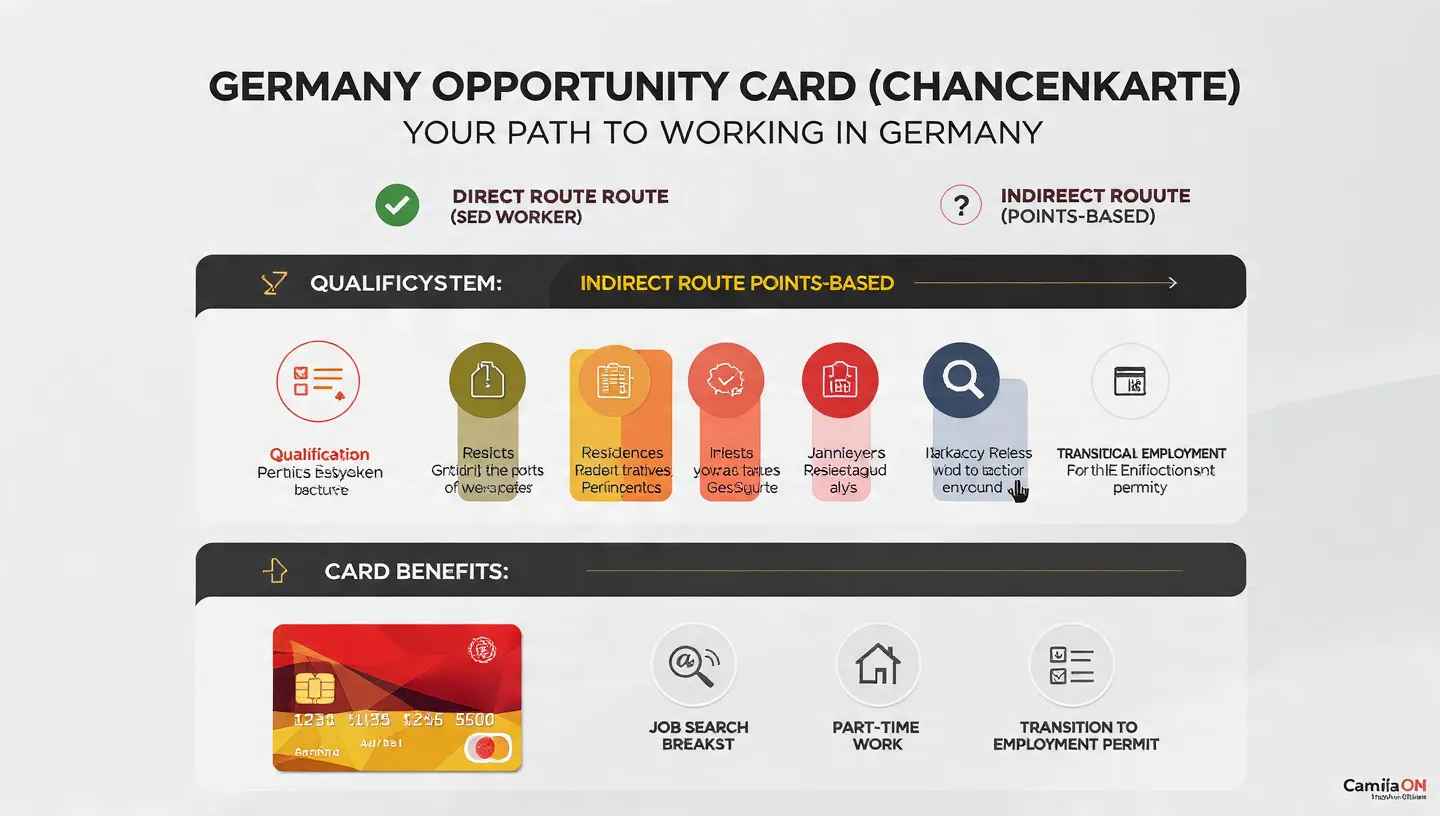
How Much Can You Work?
- Part-time: Maximum 20 hours per week (any job field doesn't matter)
- Probearbeit (Trial Work): 2-week trial placements with potential employers are allowed a powerful way to confirm a job offer
- Full-time: Once a formal job offer is received, your visa converts and full-time work begins
- Freelancing: Not permitted on the Opportunity Card job searching is the primary purpose
Best Cities for Job Seekers By Field
| City | Best Fields | Average IT Salary | Rent (1BHK/month) |
|---|---|---|---|
| Berlin | Tech, Startups, AI, Media | €55,000–€75,000/yr | €1,000–€1,500 |
| Munich | Engineering, Automotive, Finance | €60,000–€85,000/yr | €1,400–€2,000 |
| Hamburg | Logistics, Maritime, Commerce | €52,000–€70,000/yr | €1,100–€1,600 |
| Frankfurt | Finance, Banking, Fintech | €58,000–€80,000/yr | €1,200–€1,700 |
| Stuttgart | Automotive, Mechanical Engineering | €55,000–€75,000/yr | €1,000–€1,400 |
| Düsseldorf | Trade, International Business | €50,000–€68,000/yr | €900–€1,300 |
| Cologne | Media, IT, Logistics | €50,000–€68,000/yr | €900–€1,300 |
Can You Bring Your Family?
Family reunification is not directly available on the Opportunity Card. However, if your spouse is also qualified, their qualification earns you 1 extra point. After your job is confirmed, family visa processing becomes significantly more accessible, and your children can study in Germany free or at minimal cost.
Job Search in Germany Practical Tips
- LinkedIn Germany: Most widely used for professional networking in Germany. Keep your profile in German as well.
- XING: Germany's local professional network many German companies, especially mid-size firms, are very active here.
- Jobcenter / Agentur für Arbeit: Government job centers offering free counselling, job listings, and sometimes language course funding.
- Make it in Germany Portal: Germany's official immigration website also lists jobs specifically for skilled immigrants.
- Direct Applications (Initiativbewerbung): Cold applications are normal in Germany send your CV directly to companies.
- German Language: English works well in Berlin and Hamburg's IT sector, but even basic German (A2/B1) opens significantly more doors, especially in smaller cities.
Sectors With the Highest Demand (2026)
- IT & Software Development: 137,000+ vacancies highest demand of all sectors
- Nursing & Healthcare: Critical shortage fast-track options available
- Electrical & Mechanical Engineering: Manufacturing sector growing
- Construction & Skilled Trades: Physical infrastructure boom
- Teaching & Education: Especially maths, science, and languages
- Finance & Accounting: High demand in Frankfurt and Munich
What Happens After Getting a Job? Work Permit & PR Pathway
Step 1: Convert from Opportunity Card to Work Permit
When you find a qualifying job, you do not need to leave Germany. Go directly to your local Ausländeramt (foreigners office) and submit: employment contract, proof of qualifications, health insurance proof, and biometric photos. Conversion typically takes 2–4 weeks, after which you can work full-time.
Step 2: EU Blue Card Fastest Path to PR
If your job offer comes with a salary of €45,300/year (or €41,042 for shortage occupations) or more, you are directly eligible for the EU Blue Card. Benefits include PR possible in just 21 months, EU mobility across other European countries, easier family reunification, and German citizenship possible in 5 years.
Read More : Processing Time Tracker
Germany PR and Citizenship Timeline
| Visa Type | PR Eligible After | Citizenship Eligible After | Salary Requirement |
|---|---|---|---|
| Opportunity Card → Work Permit | 4 years | 8 years (5 yrs in special cases) | No minimum |
| EU Blue Card | 21 months | 5 years | €45,300+/year |
| Direct Recognized Qualification | 4 years | 5 years (new reform) | Depends on role |
Common Rejection Reasons Avoid These Mistakes
| Rejection Reason | Why It Happens | How to Avoid It |
|---|---|---|
| Incomplete documents | One or more documents missing | Check the checklist twice ideally with a consultant |
| Uncertified translations | Non-approved translator used | Only use consulate-approved translators |
| Insufficient blocked account | Amount below 2026 standard | Confirm minimum €12,324 clearly stated in bank letter |
| Degree not recognized | anabin.de not checked | Verify on anabin.de first if not listed, get NARIC assessment |
| Weak motivation letter | Job search plan was not convincing | Mention specific industries, cities, and skills |
| Health insurance gap | Coverage dates don't match visa period | Coverage must run 12 months from exact visa start date |
| Late appointment booking | No slots available during peak season | Book 6–8 weeks before documents are ready |
| Points calculation error | Wrong points claimed | Double-check with a points calculator dishonest claims risk permanent ban |
Realistic Timeline From India/Pakistan to Germany
| Phase | Duration | What to Do |
|---|---|---|
| Phase 1: Preparation | 4–6 weeks | Gather documents, translations, anabin.de check, open blocked account |
| Phase 2: Application | 1–2 weeks | Book appointment, consulate visit, submit documents, pay fee |
| Phase 3: Processing | 8–12 weeks | Wait track status regularly with the consulate |
| Phase 4: Arrival | Week 1–2 | Land in Germany, complete Anmeldung, arrange accommodation, open bank account |
| Phase 5: Job Search | 1–6 months | Applications, LinkedIn, XING, networking, Probearbeit |
| Phase 6: Job Confirmed | Variable | Apply for Work Permit at Ausländeramt |
| Phase 7: Settlement | 2–4 years | Work, learn German, integrate prepare for PR |
| TOTAL (Preparation to PR) | 5–7 years | Full Germany settlement journey realistic estimate |
Conclusion Your Germany Journey Starts Here
The Germany Opportunity Card is a landmark reform in European immigration history. For the first time, qualified professionals from India and Pakistan do not have to wait for an employer's invitation to go to Germany you can build your own future. Whether you are an engineer, IT professional, nurse, or skilled tradesperson, there is a place for you in Germany.
The historical barrier "get a job first, then you'll get a visa" is now gone. The Chancenkarte has opened that door. But opportunity windows don't stay open forever Germany's immigration rules continue to evolve. Those who act first will arrive first.
If you are serious, take your first step today: calculate your points, check your degree on anabin.de, and get guidance from a certified immigration consultant. That small bit of planning makes your entire journey smooth.
🇩🇪 Want to Move to Germany? Get a FREE consultation with our certified immigration team. Your documents will be reviewed, your points calculated, and a personalized roadmap provided. 📞 [Your Number] | 📧 [Your Email] | 💬 WhatsApp Available
Frequently Asked Questions
It is a 1-year visa that allows you to live in Germany and search for a job — without needing a job offer beforehand. You qualify by earning points, then come to Germany physically and attend interviews.
Yes, absolutely. The Germany Opportunity Card is open to all non-EU nationals India, Pakistan, Bangladesh, Philippines, Nigeria all can apply. You apply through your nearest German Consulate (Pakistan: Islamabad, Karachi, Lahore).
It is not mandatory. English C1 (IELTS 7.0+) plus work experience can complete your 6 points. However, even basic German (A1/A2) is very helpful for job searching and daily life, especially in smaller German cities.
Probearbeit means trial work placement you can do a 2-week trial with any potential employer on the Opportunity Card. It is a powerful tool: the company gets to see you work, and you understand the company culture. Many permanent jobs begin this way.
If no job is found within 1 year, your Opportunity Card expires and you must return. Extensions are only granted in exceptional cases such as a promising job process already underway. This is why going with a structured job search plan is essential.
The EU Blue Card is a high-skilled worker residence permit requiring a minimum salary threshold (€45,300/year). The Opportunity Card is its stepping stone: you arrive on the Opportunity Card, find a high-salary job, then convert to the Blue Card. With the Blue Card, PR is possible in just 21 months much faster than a regular work permit.
Not directly. You travel alone on the Opportunity Card. However, if your spouse is also qualified, their qualification earns you 1 extra point. After your job is confirmed, the family visa process becomes much more accessible.
Berlin is most popular for startups and tech companies English is widely spoken there. Munich has major companies like SAP, BMW, and Siemens with higher salaries. Frankfurt leads in fintech. Hamburg excels in media and e-commerce. For fresh professionals, Berlin is best; for experienced professionals, Munich or Frankfurt offer better returns.
The purpose of the Opportunity Card is to come to Germany and search for a job not to arrive after securing one. If you already have a job offer in Germany, apply directly for a Work Visa or EU Blue Card the Opportunity Card is not necessary.
Yes. Pathway B (points system) exists exactly for this situation. If you have 6+ points, you can apply without direct recognition. While searching for a job in Germany, you can simultaneously pursue the degree recognition process.
Share This Article