Minimum CRS Score for Canada PR 2026 : Complete Guide
Every year, hundreds of thousands of skilled workers around the world ask the same question: what is the minimum CRS score I need to get permanent residence in Canada? It sounds like it should have a simple answer. It does not, and that is exactly why so many applicants end up confused, discouraged, or applying with incomplete information.
The truth is that there is no single fixed minimum CRS score for Canada PR. The cutoff changes with every Express Entry draw, shifts based on the type of draw IRCC holds, and varies depending on whether you are competing in a general pool or a targeted category draw. A score that would not qualify you for a general draw in one month might be more than enough for a French-language or trades draw held the same week.
This guide gives you everything you need: accurate 2026 draw data, correct CRS point tables, real examples of what different score ranges can realistically achieve, and a clear strategy section that tells you exactly what to do if your score is currently too low. Whether you are just starting your Express Entry journey or you have been waiting in the pool for months, this article will give you a clear picture of where you stand and what to do next.
Understanding What the Minimum CRS Score Actually Means
There Is No Fixed Minimum: Here Is Why That Matters
When IRCC holds an Express Entry draw, it invites a specific number of candidates, typically between 500 and 5,000, starting from the highest CRS score in the pool and working downward until it reaches its target number. The score of the last candidate invited becomes that draw's cutoff score. This cutoff is not decided in advance. It is the result of how many candidates are in the pool and how many invitations IRCC issues.
This means your Minimum CRS Score for Canada PR is a moving target. If the pool is large and competitive, the cutoff goes up. If IRCC issues more invitations or holds a draw targeting a specific occupation with fewer eligible candidates, the cutoff drops. A candidate who misses one draw by three points might receive an ITA two weeks later if the cutoff drops slightly.
The Three Zones Every Express Entry Candidate Falls Into
|
CRS Score Zone |
General Draw Outlook |
What You Should Do in 2026 |
|
Below 400 |
Very unlikely for general draws |
Focus entirely on PNP, French language draws, or trades category draws |
|
400 to 460 |
Unlikely for general, possible for category draws |
Target specific category draws, apply aggressively to PNP streams |
|
461 to 490 |
Marginal for general, good for category draws |
Monitor draws closely, work on language improvement, pursue PNP |
|
491 to 520 |
Competitive for most general and category draws |
Submit profile now, update with any improvements, watch PNP options |
|
521 to 560 |
Strong candidate for all draw types |
You are well-positioned, keep profile updated and accurate |
|
Above 560 |
Excellent, near-guaranteed ITA in general draws |
Expect an ITA soon, ensure documents are ready |
Accurate 2026 CRS Draw Cutoff Data by Draw Type
General Express Entry Draw Cutoffs: Historical Trend and 2026 Projections
General draws invite candidates from all three Express Entry programs simultaneously. They represent the most competitive draw type because every eligible candidate in the pool can receive an invitation. Cutoffs for general draws have been trending between 485 and 545 through 2024 and 2025, with occasional lower drops when IRCC issues large batches.
|
Year |
Average General Draw Cutoff |
Lowest Single Draw |
Highest Single Draw |
Total ITAs Issued |
|
2022 |
521 |
491 |
557 |
Approx. 89,000 |
|
2023 |
497 |
481 |
531 |
Approx. 109,000 |
|
2024 |
504 |
479 |
534 |
Approx. 110,000 |
|
2025 |
495 |
470 |
545 |
Approx. 112,000 |
|
2026 (projected) |
488 to 510 |
475 (estimated) |
530 (estimated) |
110,000 to 120,000 |
The downward pressure on cutoff scores since 2022 reflects IRCC issuing higher volumes of invitations annually. As Canada works toward its immigration targets of over 500,000 new permanent residents per year, draw sizes have grown, which tends to pull cutoffs lower over time.
Category-Based Draw Cutoffs: The Biggest Opportunity for Most Candidates
Since 2023, IRCC has regularly held category-based draws that target specific occupation groups and language profiles. These draws have cutoffs significantly lower than general draws and represent the most realistic pathway for candidates whose scores fall in the 350 to 480 range.
|
Draw Category |
2026 Estimated CRS Range |
Who Qualifies |
Draw Frequency |
|
General (all programs) |
485 to 530 |
All Express Entry eligible candidates |
Every 1 to 2 weeks |
|
Canadian Experience Class only |
477 to 520 |
Candidates with 1+ year Canadian work experience |
Monthly |
|
Federal Skilled Worker only |
488 to 515 |
Skilled workers with foreign experience meeting FSW criteria |
Monthly |
|
Federal Skilled Trades |
280 to 360 |
Tradespeople with eligible NOC TEER 2 or 3 occupations |
Irregular |
|
French language proficiency |
336 to 390 |
Candidates with French CLB 7+ in all four abilities |
Monthly |
|
Healthcare occupations |
430 to 480 |
Nurses, doctors, therapists, paramedics, healthcare support |
Occasional |
|
STEM occupations |
481 to 510 |
Engineers, software developers, scientists, IT professionals |
Occasional |
|
Agriculture and agri-food |
300 to 420 |
Farm workers, food processing, agricultural managers |
Occasional |
|
Transport occupations |
350 to 445 |
Truck drivers, pilots, dispatchers, transport supervisors |
Occasional |
|
Education occupations |
390 to 440 |
Teachers, educational counselors, early childhood educators |
Occasional |
How Category-Based Draws Changed Everything for Lower-Scoring Candidates
Before category-based draws were introduced in mid-2023, the only way to receive an Express Entry ITA was to score high enough in a general draw. This locked out many skilled workers whose profiles were strong in their occupation but did not score well on the overall CRS formula.
Since category-based draws began, a nurse with a CRS score of 445 can receive an ITA through a healthcare draw. A truck driver with a score of 390 can receive an ITA through a transport draw. A francophone with a score of 350 can receive an ITA through a French language draw. These were not possible before 2023, and they remain active and growing in 2026.
The practical advice this creates is simple: before you assume your score is too low, find out which occupation category your NOC code falls into and check whether IRCC has held category draws for that group. The answer will often change your entire outlook.
Accurate CRS Score Tables for 2026
Many articles online contain incorrect CRS point values. The tables below reflect the actual IRCC CRS framework as of 2026. Use these to calculate your score accurately before entering it into any online CRS score calculator.
Age Points: Correct 2026 Values
|
Age |
Single Applicant |
With Accompanying Spouse |
|
17 or younger |
0 |
0 |
|
18 |
90 |
75 |
|
19 |
95 |
80 |
|
20 to 29 (peak range) |
100 |
85 |
|
30 |
95 |
80 |
|
31 |
90 |
75 |
|
32 |
85 |
70 |
|
33 |
80 |
65 |
|
34 |
75 |
60 |
|
35 |
70 |
55 |
|
36 |
65 |
50 |
|
37 |
60 |
45 |
|
38 |
55 |
40 |
|
39 |
50 |
35 |
|
40 |
45 |
30 |
|
41 |
35 |
22 |
|
42 |
25 |
14 |
|
43 |
15 |
6 |
|
44 |
5 |
2 |
|
45 or older |
0 |
0 |
Education Points: Correct 2026 Values
|
Education Level |
Single Applicant |
With Accompanying Spouse |
|
Less than secondary school |
0 |
0 |
|
Secondary school diploma |
30 |
28 |
|
One-year post-secondary credential |
90 |
84 |
|
Two-year post-secondary credential |
98 |
91 |
|
Bachelor's degree or 3-year post-secondary |
120 |
112 |
|
Two or more credentials, one 3 or more years |
128 |
119 |
|
Master's degree or professional degree |
135 |
126 |
|
Doctoral degree (PhD) |
150 |
140 |
First Official Language Points by CLB Level
|
CLB Level |
Speaking |
Listening |
Reading |
Writing |
Total (Single) |
Total (With Spouse) |
|
CLB 10 or higher |
34 |
34 |
34 |
34 |
136 |
128 |
|
CLB 9 |
31 |
31 |
31 |
31 |
124 |
116 |
|
CLB 8 |
23 |
23 |
23 |
23 |
92 |
88 |
|
CLB 7 |
17 |
17 |
17 |
17 |
68 |
64 |
|
CLB 6 |
9 |
9 |
9 |
9 |
36 |
32 |
|
CLB 5 |
6 |
6 |
6 |
6 |
24 |
20 |
|
Below CLB 5 |
0 |
0 |
0 |
0 |
0 |
0 |
IELTS General Training Band Score to CLB Conversion
|
CLB Level |
Speaking |
Listening |
Reading |
Writing |
|
CLB 10 |
7.5 |
8.5 |
8.0 |
7.5 |
|
CLB 9 |
7.0 |
8.0 |
7.0 |
7.0 |
|
CLB 8 |
6.5 |
7.5 |
6.5 |
6.5 |
|
CLB 7 |
6.0 |
7.0 |
6.0 |
6.0 |
|
CLB 6 |
5.5 |
5.5 |
5.0 |
5.5 |
|
CLB 5 |
5.0 |
5.0 |
4.0 |
5.0 |
CELPIP Score to CLB Conversion
|
CLB Level |
Speaking |
Listening |
Reading |
Writing |
|
CLB 10 |
10 |
10 |
10 |
10 |
|
CLB 9 |
9 |
9 |
9 |
9 |
|
CLB 8 |
8 |
8 |
8 |
8 |
|
CLB 7 |
7 |
7 |
7 |
7 |
|
CLB 6 |
6 |
6 |
6 |
6 |
|
CLB 5 |
5 |
5 |
5 |
5 |
Canadian Work Experience Points
|
Years of Eligible Canadian Work Experience |
Single Applicant |
With Accompanying Spouse |
|
None |
0 |
0 |
|
1 year |
40 |
35 |
|
2 years |
53 |
46 |
|
3 years |
64 |
56 |
|
4 years |
72 |
63 |
|
5 or more years |
80 |
70 |
Foreign Work Experience Points
|
Years of Eligible Foreign Work Experience |
Single Applicant |
With Accompanying Spouse |
|
None or less than 1 year |
0 |
0 |
|
1 to 2 years |
13 |
11 |
|
2 to 3 years |
25 |
21 |
|
3 or more years |
50 |
42 |
Skill Transferability Points Summary
|
Combination |
CLB 7 to 8 or 1 Year Canadian Exp |
CLB 9+ or 2+ Years Canadian Exp |
|
Post-secondary (1-2 year) + language |
Up to 13 points |
Up to 25 points |
|
Bachelor's or 3+ year credential + language |
Up to 13 points |
Up to 25 points |
|
Master's or PhD + language |
Up to 25 points |
Up to 50 points |
|
Post-secondary (1-2 year) + Canadian experience |
Up to 13 points |
Up to 25 points |
|
Bachelor's or 3+ year credential + Canadian experience |
Up to 13 points |
Up to 25 points |
|
Master's or PhD + Canadian experience |
Up to 25 points |
Up to 50 points |
|
Foreign experience (1-2 years) + language |
Up to 13 points |
Up to 25 points |
|
Foreign experience (3+ years) + language |
Up to 25 points |
Up to 50 points |
|
Foreign experience (1-2 years) + Canadian experience |
Up to 13 points |
Up to 25 points |
|
Foreign experience (3+ years) + Canadian experience |
Up to 25 points |
Up to 50 points |
Bonus Points Available in 2026
|
Bonus Category |
Points |
Key Condition |
|
Provincial Nominee Program (enhanced nomination) |
600 |
Nomination from Express Entry-linked PNP stream |
|
Canadian post-secondary study (2 or more years) |
30 |
Completed at designated learning institution in Canada |
|
Canadian post-secondary study (less than 2 years) |
15 |
Completed at designated learning institution in Canada |
|
Sibling in Canada (citizen or PR, aged 18+) |
15 |
Biological or adoptive sibling relationship |
|
French CLB 7+ AND English CLB 5 or higher |
50 |
Bilingual French and English proficiency |
|
French CLB 7+ only (no English test required) |
25 |
Strong French ability without English requirement |
Category-Based Draw Cutoffs: The Biggest Opportunity for Most Candidates
Since 2023, IRCC has regularly held category-based draws that target specific occupation groups and language profiles. These draws have cutoffs significantly lower than general draws and represent the most realistic pathway for candidates whose scores fall in the 350 to 480 range.
|
Draw Category |
2026 Estimated CRS Range |
Who Qualifies |
Draw Frequency |
|
General (all programs) |
485 to 530 |
All Express Entry eligible candidates |
Every 1 to 2 weeks |
|
Canadian Experience Class only |
477 to 520 |
Candidates with 1+ year Canadian work experience |
Monthly |
|
Federal Skilled Worker only |
488 to 515 |
Skilled workers with foreign experience meeting FSW criteria |
Monthly |
|
Federal Skilled Trades |
280 to 360 |
Tradespeople with eligible NOC TEER 2 or 3 occupations |
Irregular |
|
French language proficiency |
336 to 390 |
Candidates with French CLB 7+ in all four abilities |
Monthly |
|
Healthcare occupations |
430 to 480 |
Nurses, doctors, therapists, paramedics, healthcare support |
Occasional |
|
STEM occupations |
481 to 510 |
Engineers, software developers, scientists, IT professionals |
Occasional |
|
Agriculture and agri-food |
300 to 420 |
Farm workers, food processing, agricultural managers |
Occasional |
|
Transport occupations |
350 to 445 |
Truck drivers, pilots, dispatchers, transport supervisors |
Occasional |
|
Education occupations |
390 to 440 |
Teachers, educational counselors, early childhood educators |
Occasional |
How Category-Based Draws Changed Everything for Lower-Scoring Candidates
Before category-based draws were introduced in mid-2023, the only way to receive an Express Entry ITA was to score high enough in a general draw. This locked out many skilled workers whose profiles were strong in their occupation but did not score well on the overall CRS formula.
Since category-based draws began, a nurse with a CRS score of 445 can receive an ITA through a healthcare draw. A truck driver with a score of 390 can receive an ITA through a transport draw. A francophone with a score of 350 can receive an ITA through a French language draw. These were not possible before 2023, and they remain active and growing in 2026.
The practical advice this creates is simple: before you assume your score is too low, find out which occupation category your NOC code falls into and check whether IRCC has held category draws for that group. The answer will often change your entire outlook.
Accurate CRS Score Tables for 2026
Many articles online contain incorrect CRS point values. The tables below reflect the actual IRCC CRS framework as of 2026. Use these to calculate your score accurately before entering it into any online CRS score calculator.
Age Points: Correct 2026 Values
|
Age |
Single Applicant |
With Accompanying Spouse |
|
17 or younger |
0 |
0 |
|
18 |
90 |
75 |
|
19 |
95 |
80 |
|
20 to 29 (peak range) |
100 |
85 |
|
30 |
95 |
80 |
|
31 |
90 |
75 |
|
32 |
85 |
70 |
|
33 |
80 |
65 |
|
34 |
75 |
60 |
|
35 |
70 |
55 |
|
36 |
65 |
50 |
|
37 |
60 |
45 |
|
38 |
55 |
40 |
|
39 |
50 |
35 |
|
40 |
45 |
30 |
|
41 |
35 |
22 |
|
42 |
25 |
14 |
|
43 |
15 |
6 |
|
44 |
5 |
2 |
|
45 or older |
0 |
0 |
Education Points: Correct 2026 Values
|
Education Level |
Single Applicant |
With Accompanying Spouse |
|
Less than secondary school |
0 |
0 |
|
Secondary school diploma |
30 |
28 |
|
One-year post-secondary credential |
90 |
84 |
|
Two-year post-secondary credential |
98 |
91 |
|
Bachelor's degree or 3-year post-secondary |
120 |
112 |
|
Two or more credentials, one 3 or more years |
128 |
119 |
|
Master's degree or professional degree |
135 |
126 |
|
Doctoral degree (PhD) |
150 |
140 |
First Official Language Points by CLB Level
|
CLB Level |
Speaking |
Listening |
Reading |
Writing |
Total (Single) |
Total (With Spouse) |
|
CLB 10 or higher |
34 |
34 |
34 |
34 |
136 |
128 |
|
CLB 9 |
31 |
31 |
31 |
31 |
124 |
116 |
|
CLB 8 |
23 |
23 |
23 |
23 |
92 |
88 |
|
CLB 7 |
17 |
17 |
17 |
17 |
68 |
64 |
|
CLB 6 |
9 |
9 |
9 |
9 |
36 |
32 |
|
CLB 5 |
6 |
6 |
6 |
6 |
24 |
20 |
|
Below CLB 5 |
0 |
0 |
0 |
0 |
0 |
0 |
IELTS General Training Band Score to CLB Conversion
|
CLB Level |
Speaking |
Listening |
Reading |
Writing |
|
CLB 10 |
7.5 |
8.5 |
8.0 |
7.5 |
|
CLB 9 |
7.0 |
8.0 |
7.0 |
7.0 |
|
CLB 8 |
6.5 |
7.5 |
6.5 |
6.5 |
|
CLB 7 |
6.0 |
7.0 |
6.0 |
6.0 |
|
CLB 6 |
5.5 |
5.5 |
5.0 |
5.5 |
|
CLB 5 |
5.0 |
5.0 |
4.0 |
5.0 |
CELPIP Score to CLB Conversion
|
CLB Level |
Speaking |
Listening |
Reading |
Writing |
|
CLB 10 |
10 |
10 |
10 |
10 |
|
CLB 9 |
9 |
9 |
9 |
9 |
|
CLB 8 |
8 |
8 |
8 |
8 |
|
CLB 7 |
7 |
7 |
7 |
7 |
|
CLB 6 |
6 |
6 |
6 |
6 |
|
CLB 5 |
5 |
5 |
5 |
5 |
Canadian Work Experience Points
|
Years of Eligible Canadian Work Experience |
Single Applicant |
With Accompanying Spouse |
|
None |
0 |
0 |
|
1 year |
40 |
35 |
|
2 years |
53 |
46 |
|
3 years |
64 |
56 |
|
4 years |
72 |
63 |
|
5 or more years |
80 |
70 |
Foreign Work Experience Points
|
Years of Eligible Foreign Work Experience |
Single Applicant |
With Accompanying Spouse |
|
None or less than 1 year |
0 |
0 |
|
1 to 2 years |
13 |
11 |
|
2 to 3 years |
25 |
21 |
|
3 or more years |
50 |
42 |
Skill Transferability Points Summary
|
Combination |
CLB 7 to 8 or 1 Year Canadian Exp |
CLB 9+ or 2+ Years Canadian Exp |
|
Post-secondary (1-2 year) + language |
Up to 13 points |
Up to 25 points |
|
Bachelor's or 3+ year credential + language |
Up to 13 points |
Up to 25 points |
|
Master's or PhD + language |
Up to 25 points |
Up to 50 points |
|
Post-secondary (1-2 year) + Canadian experience |
Up to 13 points |
Up to 25 points |
|
Bachelor's or 3+ year credential + Canadian experience |
Up to 13 points |
Up to 25 points |
|
Master's or PhD + Canadian experience |
Up to 25 points |
Up to 50 points |
|
Foreign experience (1-2 years) + language |
Up to 13 points |
Up to 25 points |
|
Foreign experience (3+ years) + language |
Up to 25 points |
Up to 50 points |
|
Foreign experience (1-2 years) + Canadian experience |
Up to 13 points |
Up to 25 points |
|
Foreign experience (3+ years) + Canadian experience |
Up to 25 points |
Up to 50 points |
Bonus Points Available in 2026
|
Bonus Category |
Points |
Key Condition |
|
Provincial Nominee Program (enhanced nomination) |
600 |
Nomination from Express Entry-linked PNP stream |
|
Canadian post-secondary study (2 or more years) |
30 |
Completed at designated learning institution in Canada |
|
Canadian post-secondary study (less than 2 years) |
15 |
Completed at designated learning institution in Canada |
|
Sibling in Canada (citizen or PR, aged 18+) |
15 |
Biological or adoptive sibling relationship |
|
French CLB 7+ AND English CLB 5 or higher |
50 |
Bilingual French and English proficiency |
|
French CLB 7+ only (no English test required) |
25 |
Strong French ability without English requirement |
What Is the Minimum CRS Score for Each Express Entry Program?
There is an important distinction between program eligibility and draw competitiveness. To enter the Express Entry pool, you must meet the minimum eligibility requirements for at least one of the three programs. There is no minimum CRS score to enter the pool. Once in the pool, your CRS score determines when you receive an ITA.
|
Program |
Minimum CRS to Enter Pool |
Typical Draw Cutoff Range in 2026 |
|
Federal Skilled Worker Program (FSWP) |
No minimum CRS required |
488 to 515 |
|
Federal Skilled Trades Program (FSTP) |
No minimum CRS required |
280 to 360 |
|
Canadian Experience Class (CEC) |
No minimum CRS required |
477 to 520 |
|
Express Entry-linked PNP (after nomination) |
No minimum (600 added) |
Virtually any score |
Monitoring CRS Score Cutoffs and Knowing When to Apply
How to Track IRCC Draw Results in Real Time
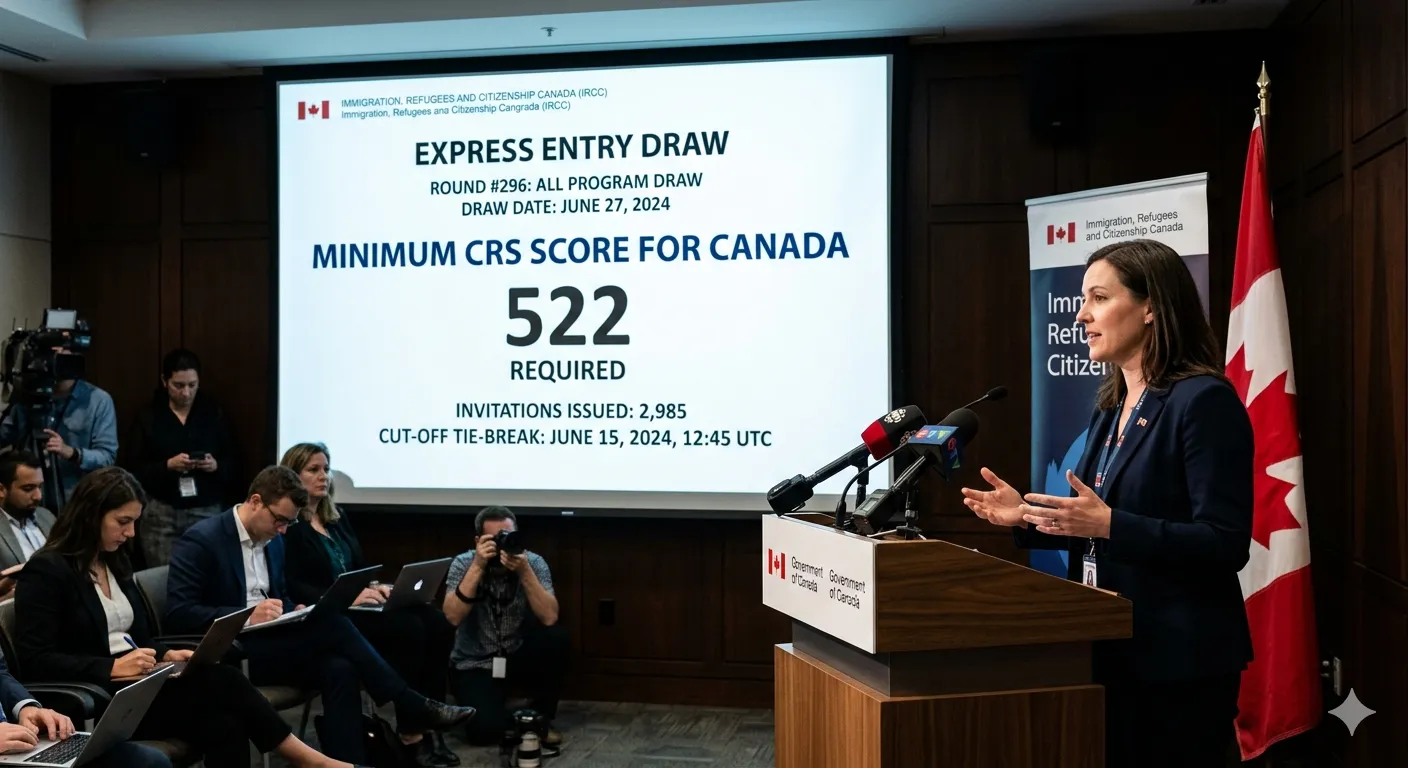
IRCC publishes the results of every Express Entry draw on the official Government of Canada website shortly after each draw is held. Each draw result includes the draw date, the type of draw, the number of invitations issued, the CRS cutoff score, and the tie-breaking rule applied.
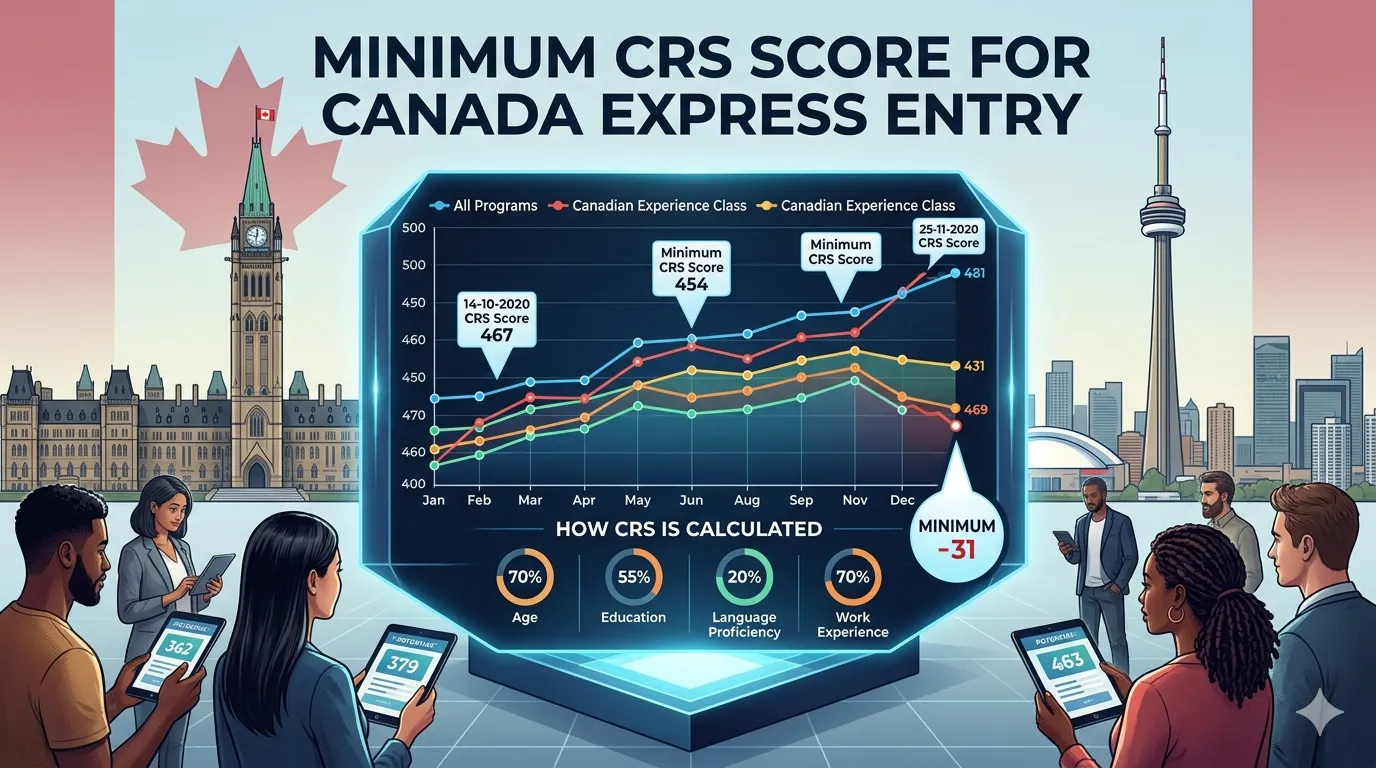
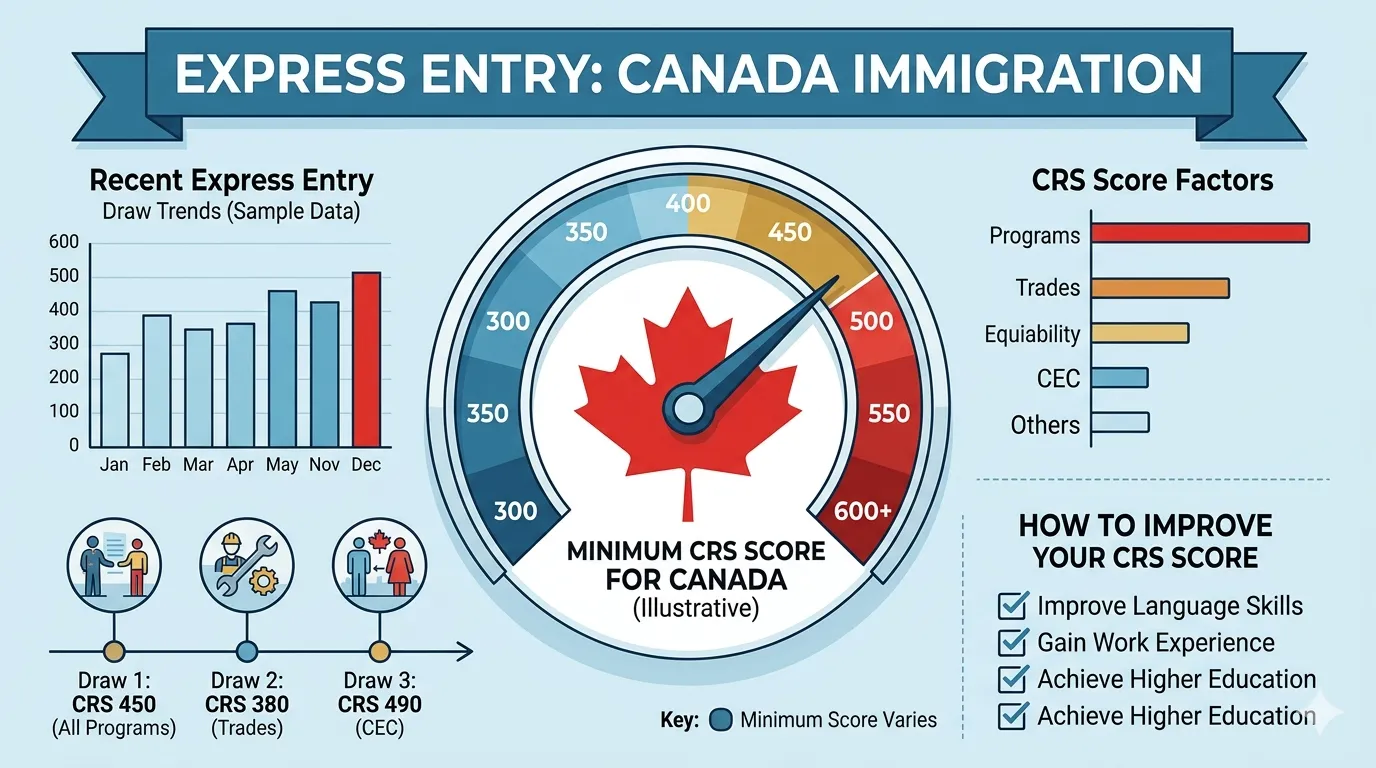
Tracking this data over time gives you a clearer picture of trends and helps you estimate when your score might be reached. Tools on immigration websites aggregate this data and display it in chart form, making it easier to see whether cutoffs are rising, falling, or holding steady over recent months.
The Tie-Breaking Rule: What Happens When Scores Are Equal
In every Express Entry draw, IRCC sets a CRS cutoff score and a specific date and time as a tie-breaker. If the number of candidates at the cutoff score exceeds the number of remaining invitations, only the candidates who submitted their profile before the tie-breaking date and time receive an ITA. Candidates with the same cutoff score but a later profile submission date are not invited.
This means that submitting your Express Entry profile as early as possible is always beneficial. Two candidates with identical CRS scores who entered the pool on different dates will be treated differently in a draw where the tie-breaker applies. The earlier submission date gets priority.
How Long Can You Stay in the Express Entry Pool?
An Express Entry profile remains active for 12 months from the date of submission. If you do not receive an ITA within that time, your profile expires and you must submit a new one. There is no limit on how many times you can resubmit. Your CRS score is recalculated each time based on your current information, which means a new profile submission reflects any improvements you have made since the previous profile.
Many candidates submit multiple profiles over one to three years, gradually improving their score through language retests, additional Canadian experience, or PNP nominations, until they finally receive an ITA. The process is a marathon for some profiles, but it is not disqualifying to expire and resubmit.
Read More : calculate crs score canada
CRS Score Ranges and What Each Range Means for Your PR Chances
|
CRS Score Range |
General Draw Chance |
Category Draw Chance |
Recommended Strategy |
|
Below 350 |
Very low |
Possible (trades, agriculture, French) |
PNP is the primary path; explore all provincial streams actively |
|
350 to 399 |
Very low |
Low to moderate |
Target French language draws, agricultural draws, trades draws based on occupation |
|
400 to 449 |
Low |
Moderate |
Category draws are realistic; pursue PNP aggressively; improve language score |
|
450 to 479 |
Low to moderate |
Good |
CEC or category draws likely; monitor every draw; language improvement still valuable |
|
480 to 499 |
Moderate |
Very good |
Competitive in most category draws; approaching general draw territory; keep profile updated |
|
500 to 529 |
Good |
Excellent |
Strong position in general and all category draws; expect ITA within 3 to 9 months |
|
530 to 559 |
Very good |
Near certain |
Top-tier pool position; ITA expected in most general draws |
|
560 and above |
Near certain |
Certain |
Expect an ITA in one of the next draws; prepare documents now |
Conclusion
The minimum CRS score for Canada PR in 2026 is not a fixed number you need to memorize. It is a range that shifts with every draw, varies across draw types, and responds to how many candidates are in the pool and how many invitations IRCC issues. What matters most is understanding where your score sits relative to the specific draw types available to you, then taking targeted action to close any gap that exists. Use the CRS score calculator on this site to get your current estimate, compare it against the accurate cutoff data in this guide, and build a clear action plan around the strategies that fit your profile and timeline. The path to Canadian permanent residence in 2026 is more open than many candidates realize once you understand how the system actually works.
Frequently Asked Questions
There is no single fixed minimum CRS score for Canada PR in 2026. General Express Entry draws have been requiring scores between 485 and 530. Category-based draws have far lower cutoffs, with French language draws inviting candidates with scores as low as 336 and trades draws going down to 280. The cutoff changes with every draw based on pool size and the number of invitations IRCC issues. Your effective minimum depends on which draw type you are targeting.
A score of 400 is generally not competitive for general all-programs draws in 2026, where cutoffs have been consistently higher. However, a score of 400 may be sufficient for agriculture draws, trades draws, or French language draws if your occupation and language profile match those categories. Additionally, applying for a provincial nomination through a PNP stream is a realistic option at this score level. Many provinces do not have a minimum CRS requirement for their own selection process.
Yes. Thousands of candidates received ITAs in 2024 and 2025 with scores below 470 through category-based draws. Healthcare, transport, agriculture, trades, and French language draws all had cutoffs well below 470 in multiple rounds. Additionally, any candidate who receives a provincial nomination has 600 points added to their score, making the base score irrelevant for receiving an ITA. A score of 350 with a PNP nomination results in a total score of 950, which guarantees an invitation.
IRCC designates eligible occupations for each category-based draw using NOC TEER codes and specific occupation titles. The list of eligible occupations for each category is published on the Government of Canada website. To find out which category applies to you, identify your NOC code using the IRCC NOC finder, then cross-reference that code against the published eligible occupation lists for each draw category. If your occupation appears in the healthcare, STEM, transport, agriculture, trades, or education list, you are eligible for that category's draws.
CRS cutoffs generally move in both directions depending on pool size and ITA volume. When IRCC issues more invitations per draw, cutoffs tend to drop because more candidates are invited, reaching further down the pool. When the pool grows faster than invitation volume, cutoffs rise. Since 2022, the trend has been moderately downward as IRCC increased annual ITA targets to meet growing immigration levels. Projections for 2026 suggest cutoffs will remain in the 485 to 510 range for general draws, though category draws will continue offering significantly lower entry points.
The fastest improvement available to most candidates is retaking their English or French language test. Moving from CLB 7 to CLB 9 in all four IELTS abilities adds 56 points to a single applicant's score and takes 8 to 16 weeks of focused preparation. Moving from CLB 8 to CLB 9 adds 32 points in the same timeframe. A French language improvement from zero to CLB 7 takes longer, typically 12 to 18 months, but adds 25 to 50 bonus points on top of the core language score. PNP nomination can add 600 points but the timeline depends on the province and the stream.
Most PNP streams linked to Express Entry do not have a fixed minimum CRS score for candidates to apply. Each province uses its own selection criteria, which may include occupation demand, ties to the province, a job offer from a provincial employer, or language ability. Some streams, such as BC PNP Tech and Ontario's Human Capital Priorities stream, do set internal score thresholds that change based on how competitive their applicant pool is, but these are not the same as IRCC's CRS cutoffs. The key is to research each province's current draw results to see the score ranges being nominated.
No. You should submit your Express Entry profile as early as possible regardless of your current score, for two important reasons. First, the profile submission date serves as a tie-breaker when two candidates have equal scores at a draw cutoff. An earlier date gives you priority. Second, your profile can be updated after submission whenever your circumstances improve, such as a new language test result, a new job offer, or a PNP nomination. By submitting early, you establish a presence in the pool, remain eligible for all upcoming draws, and lose nothing by waiting while you work on improving your score.
Share This Article